
.gif&w=256&q=75)

HireTalentt.com is a platform, built by InfoMover Technologies.
2022 © Copyright Infomover. All Rights Reserved
Privacy Notice2022 © Copyright Infomover. All Rights Reserved



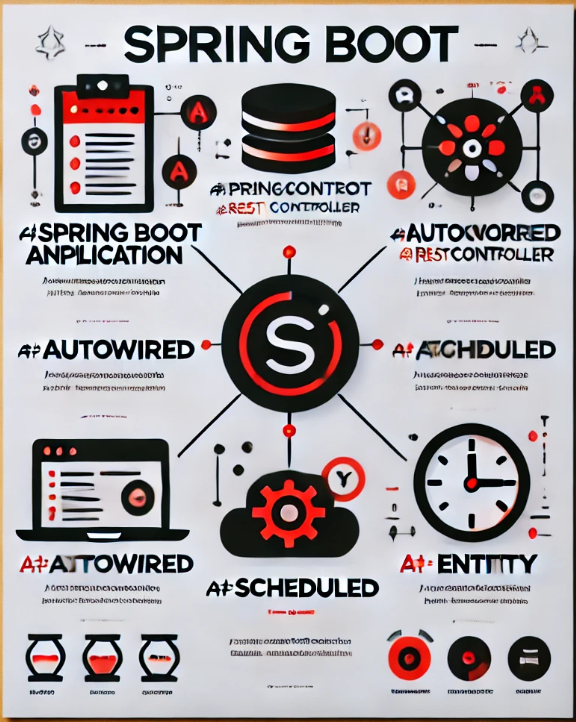
Spring Boot is a powerful framework that simplifies the development of Java applications by reducing boilerplate code and configuration. Central to this framework are annotations, which serve as metadata to inform the framework how to manage components, configure beans, and handle application logic. This blog will delve into the most useful Spring Boot annotations, their workings, and their significance.

1. @SpringBootApplication This is a composite annotation that combines three essential annotations: @EnableAutoConfiguration: Automatically configures Spring Boot based on the dependencies in your project. @ComponentScan: Scans the package and its sub-packages for components, configurations, and services. @Configuration: Marks the class as a source of bean definitions.
2. @RestController Combines @Controller and @ResponseBody, making it ideal for creating RESTful web services.
3. @Autowired Used for dependency injection, it allows Spring to automatically resolve and inject the required beans.
4. @Component, @Service, @Repository These annotations mark classes as Spring-managed beans. Each serves a slightly different purpose: @Component: Generic stereotype for any Spring-managed component. @Service: Indicates a service layer class. @Repository: Indicates a data access layer and enables exception translation for database operations.
5. @Configuration and @Bean @Configuration indicates that a class contains bean definitions, while @Bean declares individual beans.
6. @EnableScheduling and @Scheduled Enable and schedule tasks to run at fixed intervals or specific cron expressions. 7. @Entity and @Table Used with JPA to map Java classes to database tables.
//1
@SpringBootApplication
public class MySpringBootApplication {
    public static void main(String[] args) {
        SpringApplication.run(MySpringBootApplication.class, args);
    }
}
// 2
@RestController
public class MyController {
    @GetMapping("/greet")
    public String greet() {
        return "Hello, World!";
    }
}
// 3
@Service
public class MyService {
    public String serve() {
        return "Service Layer";
    }
}

@RestController
public class MyController {
    @Autowired
    private MyService myService;

    @GetMapping("/service")
    public String callService() {
        return myService.serve();
    }
}
// 4
@Component
public class MyComponent {
    public String process() {
        return "Component Layer";
    }
}
// 5
@Configuration
public class AppConfig {
    @Bean
    public MyComponent myComponent() {
        return new MyComponent();
    }
}
// 6
@EnableScheduling
@Configuration
public class SchedulerConfig {
    @Scheduled(fixedRate = 5000)
    public void performTask() {
        System.out.println("Task executed every 5 seconds");
    }
}
// 7
@Entity
@Table(name = "users")
public class User {
    @Id
    @GeneratedValue(strategy = GenerationType.IDENTITY)
    private Long id;

    @Column(name = "name")
    private String name;
}
I’m a Computer Science graduate currently working at InfoMover Technologies, where I’m gaining hands-on experience in backend and full-stack development. I work with programming languages like Python and Java, and have developed strong skills in Django, Django Rest Framework, and JavaScript. At InfoMover, I actively contribute to real-world projects, building...





 (1).jpg)
